A reunion 56 years in the making
A chapter of my life closed on Friday 07-10 when my mother's ashes were buried in a grave next to her own mother. Mother and daughter are reunited after being apart for 56 years. I wrote extensively about my mother and her mother in a Mother's Day post, and I strongly encourage you to read it before proceeding, as what I will write is a direct follow-up. If you don't read it, you may be lost with the references and callbacks, so if you need to pause your reading here, please follow the above link, then return here when finished.
Welcome back. Last month, I had thought I said all that was necessary about my mother's life. I had concluded by hoping her burial would allow me to better understand my feelings about our time together. Perhaps today's post is part of that process. To be honest, some of my own feelings at the gravesite and afterwards came about due to how others reacted, as if I needed some catalyst to motivate my own thinking.
The burial service was short and sparsely attended, likely due to it being on a Friday. Besides myself and L., the other attendees were my father R., my stepmother K., and D., a lifelong friend of my mother and someone my father knew during his first marriage. Both L. & I read sections from the Trisagion for the Dead, then invited everyone else to make comments or express their feelings about my mother. All of these actions lasted only 10 minutes at most.
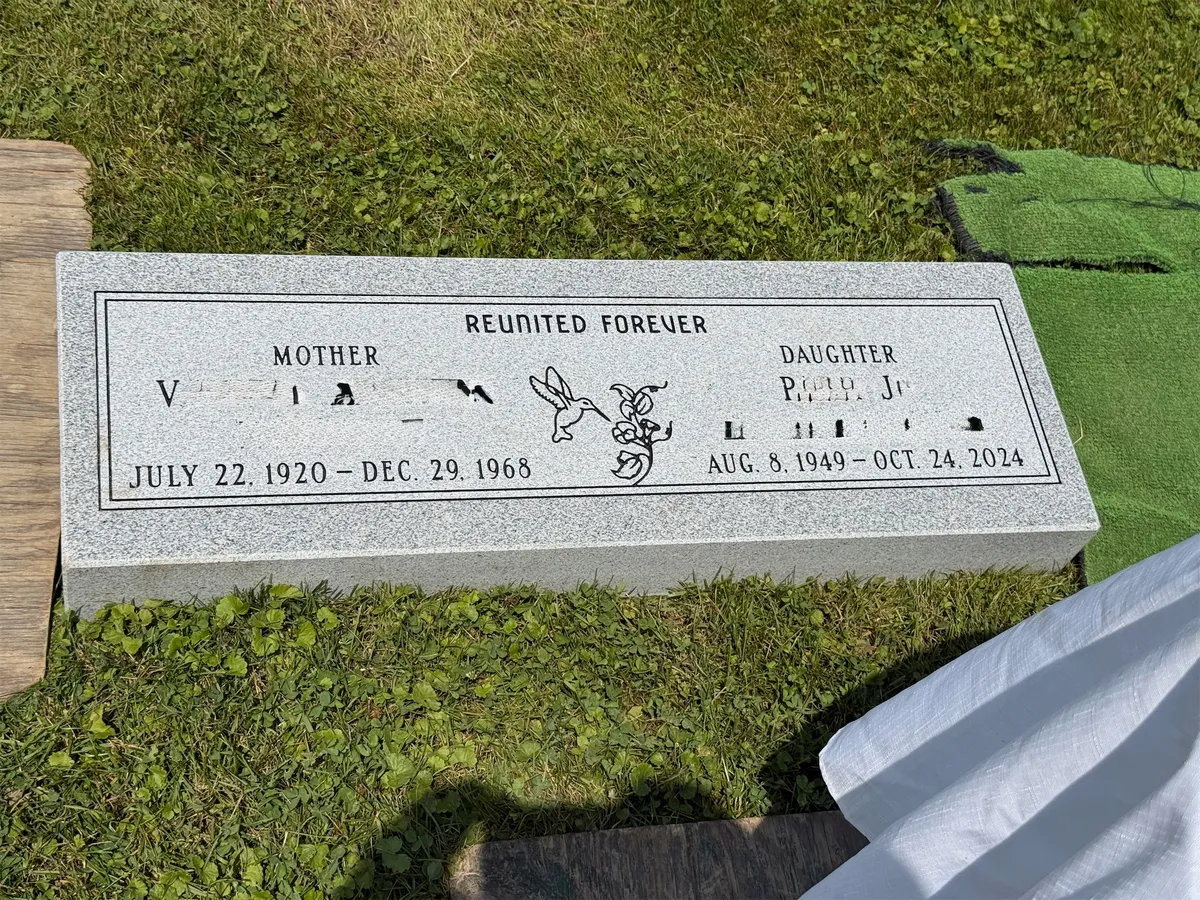
I will admit to being fascinated by the actual burial process itself. The ground at V.'s grave was already prepared to receive my mother, and as a surprise bonus, the grave marker I ordered in June had arrived earlier this week. Prior to the ceremony, I made my final payment for the tombstone, so it should be installed later this month. For this service, the marker was laid out on the ground in the approximate location of its installation. Two plywood planks were on the ground; one covering the hole made by removing the old tombstone, with the other being where my mother's ashes would be interred. Nearby the gravesite was a chunk of grass and soil that was previously excavated by the grounds crew. I handed the box with my mother's ashes to the head groundskeeper, who placed it into the hole and covered it with three buckets of dirt. Once finished, he inserted the chunk of grass and soil removed earlier, then used a square tamper about 2 feet on each side to ram it into the ground. When all was finished, there were few signs of the burial itself, apart from a section of grass that appeared to be flatter than its surroundings.
Once my mother's ashes were buried, all five of us talked for a few more minutes at the gravesite. R. had not seen D. for many years, so they caught up with folks they knew in common. My father specifically asked D. about N.’s mother L.A., both of whom I mentioned in my Mother’s Day post. L.A. had long been suffering from dementia, but her recent diagnosis of early-stage Alzheimer’s helped N. reach some sort of rapprochement with her estranged mother. N. helped her move out of her south suburban Chicago townhome, as she was increasingly incapable of caring for herself, south to Kentucky where N. now lives with her family. She placed L.A. in a memory care facility in the western part of Kentucky (likely in Paducah), and from what D. said, the quality of her life has dramatically improved thanks to the move. Both my father and I were happy to hear this update, as we both feel that L.A.'s mental decline presaged my mother's own erratic mental behavior during her last couple of years. At least one of those two lifelong friends received help for her condition.
Prior to our departure, I asked D. about her phone call with my mother back in mid-October 2024. She was the last person my mother spoke with before she died, and based on what I saw in her cell phone records, the call with D. lasted for almost 90 minutes. All that D. could remember (or was willing to share) was that my mother seemed lost and worried about her own health issues, but didn't sound like she was despondent or sad. I was hoping for more details, but as the call took place nearly 21 months ago, I will have to be satisfied with what D. provided me. To be honest, I was hoping for more clues about her emotional and mental status at that time, as I still toy with the idea that my mother may have decided to end her own life. Regardless of how it happened, her death was sudden, but there's little difference between her heart stopping from cardiac arrest or from taking too many painkillers with booze. The results in either case were the same.
When we returned to my parents' house, my father was understandably in a subdued mood. Dealing with the business of death this year, along with the gap between my mother's death and burial provided me with a lot of time to process the finality of what happened. Meanwhile, R. confronted this finality at the same gravesite he last saw in early January 1969 when V. was buried. Combining present experiences with past memories took a lot out of him emotionally, and once we were back in his house he relayed a couple stories that added more details to what I had already known.
I was familiar with how V. died in late December 1968, as she succumbed at the age of 48 to pneumonia. Her death was apparently just one statistic in the Hong Kong flu pandemic, which reached the US in September 1968, then rapidly hit its apex around Christmas. V.'s smoking and family history meant she was unfortunately a perfect target for such a devastating flu. Her death, as detailed in the earlier post, led to lifelong consequences for my mother, which included her attempts at finishing college. I had known my mother attended two colleges in two years: NIU for her freshman year in 1967-68; then ISU in 1968-69. She was engaged to my father at the end of her sophomore year at ISU, then followed him to New Jersey1 after he was drafted by the Air Force. My mother's father, M., expressed his wishes for his daughter to finish college, so during her own time in New Jersey, she attended classes at nearby Rider College (now Rider University). M. himself was engaged to the recently-divorced R., who bluntly told my father at my mother's bridal shower that they should not expect any help for my mother's continuing education. As far as R. was convinced, my mother's education was now someone else's responsibility, a view she later expanded to cover my mother's entire being.
Earlier today, N. reached out to me via text after I sent her a photo of the tombstone that will be installed soon. She may have already received a photo from D., but I sent mine all the same as a pretext to let her know how the event turned out. N. wasn't able to attend due to other family obligations, unfortunately. Her comments were the source of the earlier article's title, but this time there were no poignant phrases worth repeating. She complimented me on the tombstone design, verified D.'s story about L.A. enjoying a fishing expedition with her memory care folks, and that was that. It was a short but pleasant way to wrap up the chapter of events surrounding my mother's burial. I feel relieved that it is over and my mother received the burial she deserved. And I won't lie here, as I feel a sense of pride with these accomplishments. I had some doubts and worries that delayed my actions for a while, but thanks to some discussions with L., and with a work-provided counselor, I broke through those doubts and found my worries were merely mirages.
From here on out, I am sure that I will have moments like what my father had after the burial. Random memories will pop up here and there, some of which will be happy, but others may make me angry or wistful instead. I don't believe there will be many sad memories of my mother in the future, as I have already done the majority of my grieving long ago. I think the best way to honor my mother's memory is by living the life she wasn’t able to live. N. shared that even though she wasn't a great mother, she loved me very much. I hope living this way keeps this love of hers alive from the next world.
My father, a lifelong Cubs fan, had to suffer the indignity of living in central New Jersey during the Cubs' collapse in September 1969 and the rise of the "Miracle Mets."↩